
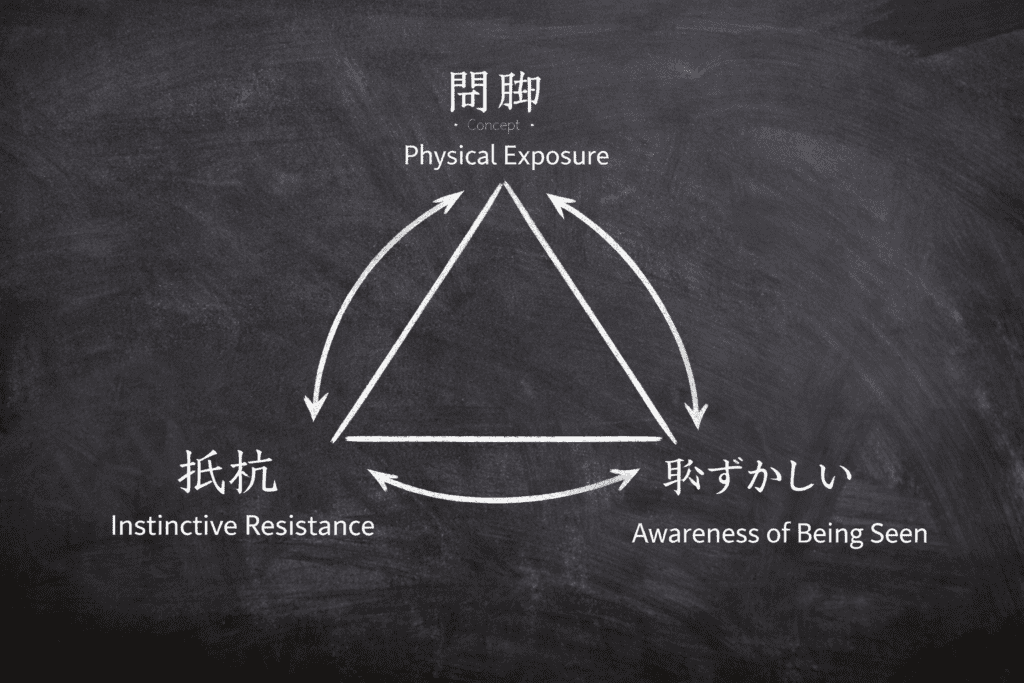
This diagram maps out the relationship among the three core principles: Exposure, Embarrassment, and Resistance. They are all connected and mutually reinforcing. They are also experienced differently for the person tying and the person being tied.
Both partners in a kotobazeme scene have different goals and reactions to kotobazeme and hazukashii play. These notes line of comparable roles in the scene and map out the focus for each participant.
Minimal 10 Phrase Core Set (Yukimura-style)
These are some phrases Yukimura would incorporate into his kotobazeme frequently and are a good guide to both the subtle and powerful nature of simple questions. You should feel free to use these, change them, and make them your own.
1. 今(いま)どう感(かん)じる?
How does it feel right now?
→ anchors the model in present sensation
2. 恥(は)ずかしい?
Is it embarrassing?
→ opens the emotional layer without forcing it
3. 見(み)られてるの分(わ)かる?
Do you realize you’re being seen?
→ shifts awareness outward
4. 息(いき)変(か)わったね。
Your breathing changed.
→ marks the moment something real happened
5. 力(ちから)入(はい)ってるよ。
You’re tensing.
→ brings attention to resistance in the body
6. 抵抗(ていこう)してるね。
You’re resisting.
→ names the instinct without correcting it
7. 我慢(がまん)してるの?
Are you trying to endure it?
→ invites tension between control and feeling
8. そんな顔(かお)してるよ。
You’re making that face.
→ reflects unconscious expression back to the model
9. 少(すこ)し開(ひら)くね。
I’m opening you a little.
→ pairs physical action with awareness
10. そのままでいい。
Stay just like that.
→ stabilizes the moment so it can deepen
How To Use Them
Tthe same phrase repeats, but lands differently each time.
Are you embarrassed?「恥ずかしい?」 early = light curiosity and suggestion
Are you embarrassed?「恥ずかしい?」 later = unbearable clarity
The Real Rule Beneath the Words
If you remember: Say less than you think. And say only what is true.